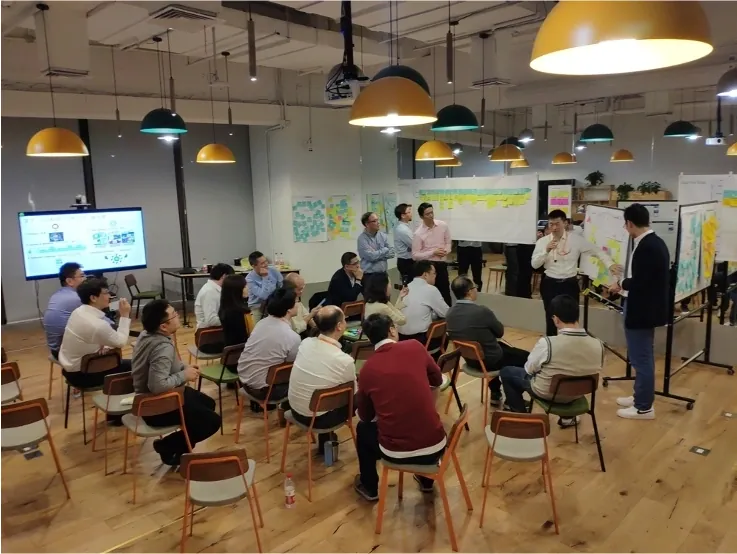
The corporate track

Leaders change faster when the environment changes with them.

Cohorts of 8 to 12 leaders from one organisation, with a named executive sponsor and line sponsors who commit to dated changes in the workplace.

Two tracks, one method

Only the route to the environment changes.

Individual track

For
Leaders at a role transition: first-time managers, founders, new executives, successors, leaders returning after a break.
Entry
Personal application, or through GCI membership.
Environment
The participant recruits a sponsor where one exists; otherwise the plan concentrates on what the participant controls.
Reporting
The participant owns the record.
Follow-up
Three and six months.

Corporate track

For
Cohorts of 8 to 12 leaders from one organisation.
Entry
An enterprise engagement with a named executive sponsor.
Environment
Each participant’s line sponsor signs a compact of dated actions.
Reporting
The organisation sees themes and agreed adjustments, in aggregate.
Follow-up
Three and six months, plus a check that adjustments are still in place.

Same five-lens profile, same goals discipline, same follow-up at three and six months.

For organisations, the environment is part of the work

Four additions that turn recommendations into assigned actions.

  1. 1

    Sponsor compact

    Each line sponsor commits to two or three named changes with dates, such as protected time, clearer decision rights or a different brief.

  2. 2

    Environment scan

    Workload, meeting load, decision rights and psychological safety are examined, and each finding is recorded as a barrier or a facilitator. Refusals and unresolved barriers are documented, because they affect how outcomes should be read.

  3. 3

    Strengths-based inquiry

    One working session with participants and sponsors on what already works in the organisation, using the four Appreciative Inquiry stages: Discover, Dream, Design, Destiny.

  4. 4

    Aggregate reporting

    The organisation receives themes, adjustments made and goal outcomes by category. It never receives an individual’s profile, scores or coaching record.

A recommendation in a report has limited practical value if no person or organisation is responsible for carrying it out.

WHO ICF implementation report, section 5

So every environmental action has an owner, a date and a check that it happened.

What a corporate engagement looks like

An illustrative plan. Every element has an owner and a piece of evidence that shows it happened.

Illustrative

A 300-person professional services firm enrols ten newly promoted team leaders

The executive sponsor wants the new leaders to hold regular one-to-ones and to stop escalating routine decisions to partners.

Illustrative corporate plan
ElementActionOwnerEvidence
Environment scanShort survey and interviews on workload, meeting load, decision rights and psychological safetyCoordinator with the firm’s HR leadBarriers and facilitators agreed with the executive sponsor
Sponsor compactsEach line sponsor signs two or three dated actionsLine sponsorsActions confirmed at weeks 6 and 10
Strengths-based inquiryHalf-day session with participants and sponsors on what already worksPositive psychology coachThree practices the firm commits to keep
Individual plansTwo or three participation goals per leaderParticipant and steward mentorGoal attainment at week 12
Aggregate reportThemes, adjustments made and goal outcomes by categoryOutcomes leadReport to the executive sponsor; no individual data
Follow-upRole status and whether adjustments are still in placeCoordinatorThree and six months

Success stories

Cohorts and workshops GCI has run with leading organisations, delivering capability and job-impact outcomes.

Proven outcomes with

These are earlier GCI engagements. The ARISE Leadership Transformation Programme Series pilot has not yet run, and its results will be reported only after follow-up.

Aggregate reporting, and a record the leader owns

What the organisation receives

  • Themes across the cohort
  • Adjustments agreed and made
  • Goal outcomes by category
  • Whether adjustments are still in place at follow-up

What it never receives

  • An individual’s five-lens profile
  • Wellbeing or psychological capital scores
  • Coaching notes
  • The participant’s story

Each disclosure has a stated purpose, a named recipient and the participant’s consent, in line with Singapore’s Personal Data Protection Act.

Evidence before expansion

Eighteen months from design to a reviewed result. Timing is illustrative.

  1. Months 1–3

    Design

    Confirm demand. Appoint leads. Train and calibrate stewards on shared cases. Sign the referral partner.

    Evidence before moving onClear scope, a usable record, agreed outcome definitions.

  2. Months 4–6

    First cohort

    Run one open cohort of twelve. Review early cases and administration time.

    Evidence before moving onShared plan used as designed; manageable burden on participants.

  3. Months 7–12

    Second and corporate cohorts

    Run a second open cohort and the first corporate cohort. Begin three-month follow-ups.

    Evidence before moving onReliable outcome capture; documented delivery cost.

  4. Months 13–18

    Review

    Complete six-month follow-ups. Review sustained results.

    Evidence before moving onCredible participation results and a funded plan.

Plan a cohort with us.

Tell us about the leaders you have in mind and the transition they are making. We will come back with how a corporate cohort would run in your organisation.